
Sailfish
Sailfish in Central America - The Ultimate Guide
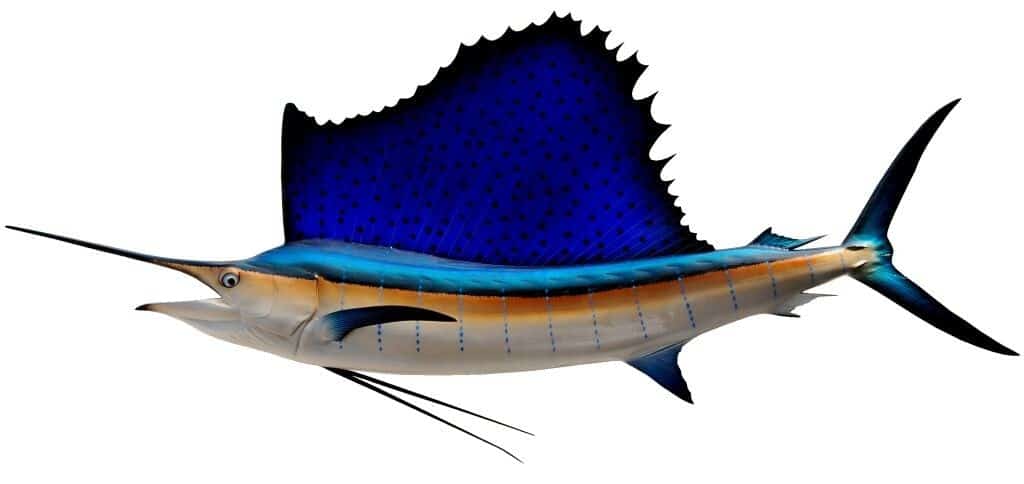
Sailfish are the ultimate trophy fish as they are abundant, display huge leaps and tail walks when hooked, and they tire quickly so they can be caught on light tackle. Like most billfish, their top jaw is roughly twice as long as their bottom jaw. Highly migratory, it is believed that sailfish will travel up to 200,000 miles throughout the course of their lives. Most fish in the wild live 4-5 years, but they can live as many as 16 years. When they aren’t feeding, sailfish are often seen swimming lazily at the surface, which often times is a sign of breeding. The female will swim slowly with her dorsal fin above the surface to attract males, and once joined, she can release over 4,000,000 eggs in a single spawn. All sailfish in Central America are catch and release.
|
SCIENTIFIC NAME |
Istiophorus platypterus (Pacific) / Istiophorus albicans (Atlantic) |
|
COMMON NAMES |
Sailfish, Sail, Pez Vela |
|
RANGE |
Tropical and subtropical oceans worldwide. In Central America, found in the Pacific (Costa Rica, Guatemala, El Salvador, Panama) and Atlantic (Belize, Caribbean) |
|
HABITAT |
Pelagic and highly migratory. Found in open ocean above the thermocline, typically in water 200–600 ft deep. |
|
COMMON PREY |
Ballyhoo, flying fish, squid, bonito, mackerel, sardines, small dorado |
|
AVERAGE SIZE |
Pacific sailfish: 80–120 lbs, up to 134 inches. Atlantic sailfish: 60–100 lbs, up to 124 inches. |
|
IGFA ALL-TACKLE WORLD RECORD |
Pacific: 221 lbs – Santa Cruz Island, Ecuador (1947). Atlantic: 142 lbs 6 oz – Luanda, Angola (2014) |
|
PROTECTION STATUS |
Catch-and-release is required by law for sport fishing boats throughout Central America. |
|
TABLEFARE QUALITY |
Sailfish are not eaten in Central America. All are strictly catch-and-release. Their firm, dark meat is not considered desirable and their value as a sport fish far outweighs any food value. |
What do Sailfish Eat?
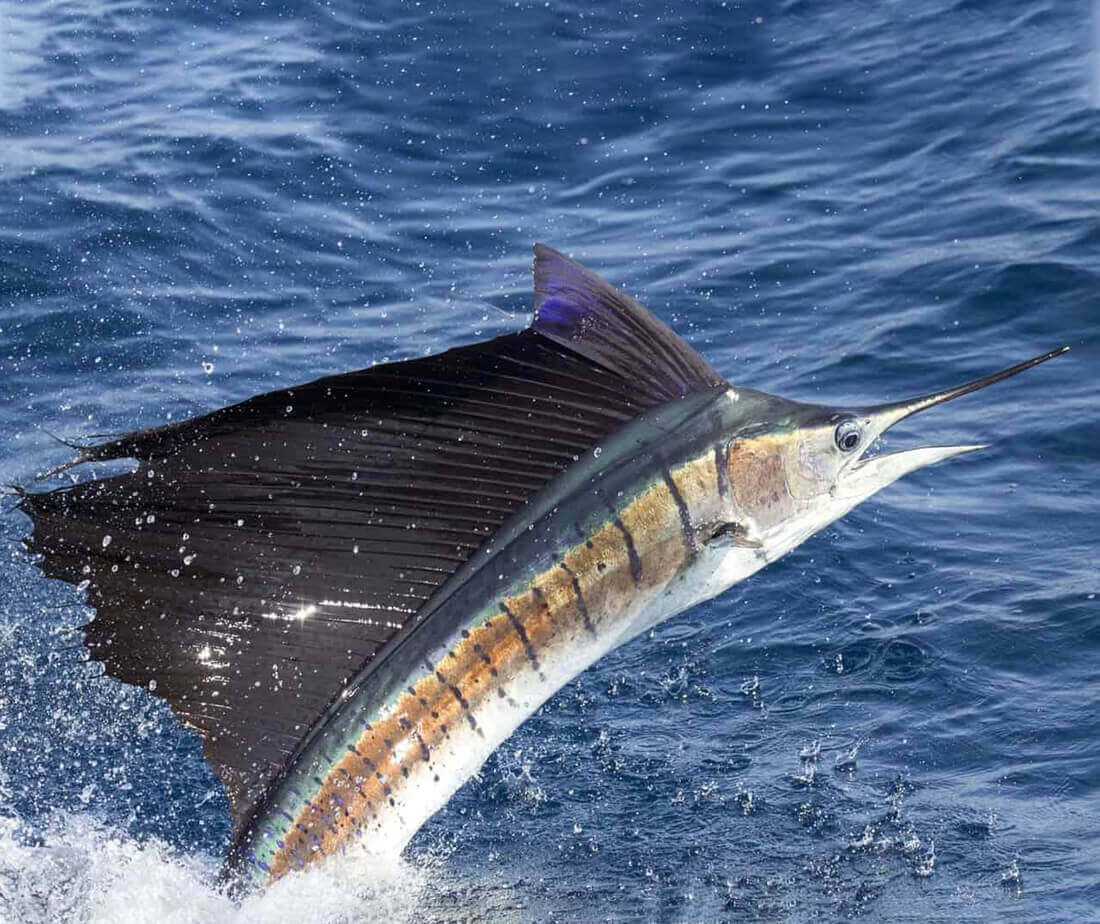
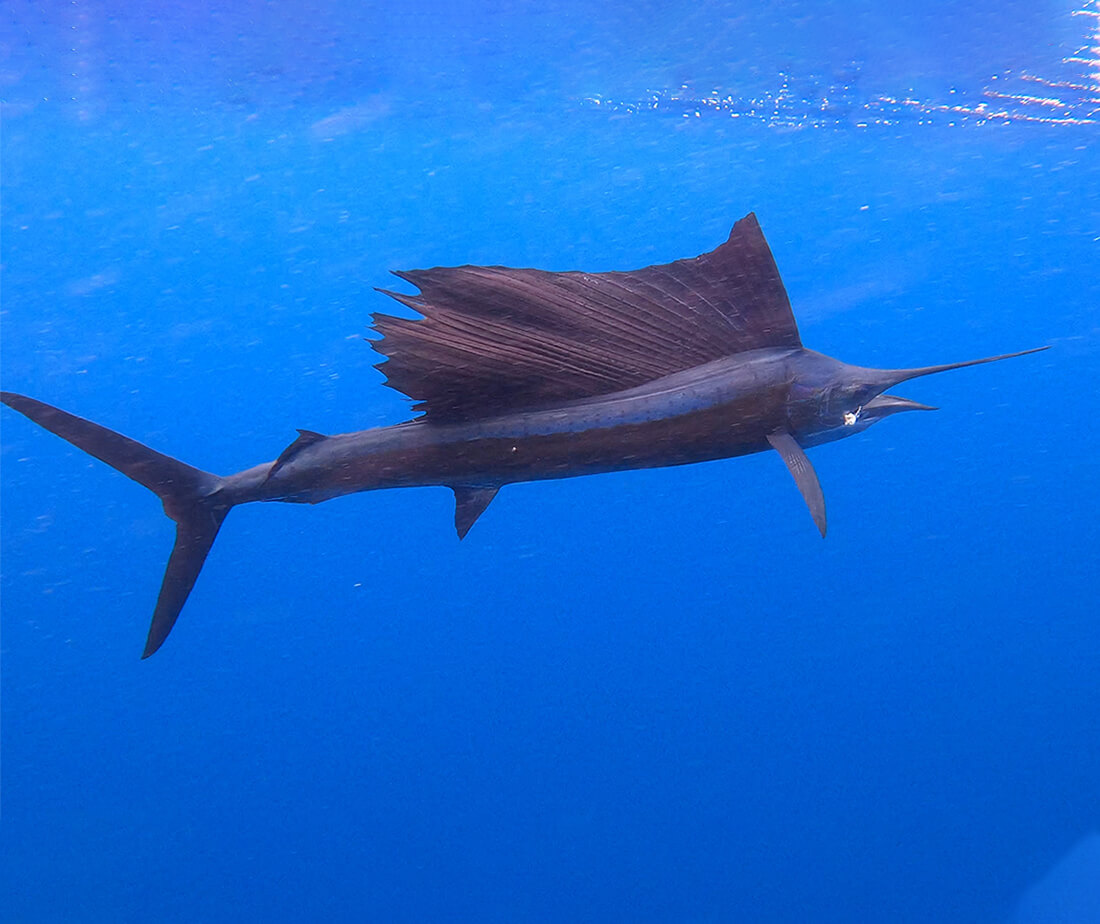
Similar to marlin, sailfish feed on smaller pelagic species like bonito, ballyhoo, flying fish, squid, mackerel and small dorado. The giant dorsal fin that they can expand and retract serves as the namesake and most identifiable feature of this popular game fish. When feeding, sailfish will expand their dorsal fins like giant sails to appear larger and frighten the baitfish into tighter schools near the surface which makes for easier hunting. When sailfish hunt they use incredible bursts of speed to whack their prey with their bills, which stuns or kills them so they can eat at leisure. They have been clocked at speeds over 65 mph!
How Big are Sailfish in Central America?
Sailfish in Central America typically measure 7–10 feet from bill to tail, but their size varies by which ocean you fish on and which species of sailfish you catch. Pacific sailfish are generally larger, commonly weighing 80–120 pounds, while Atlantic sailfish found in the Caribbean usually weigh 60–100 pounds. We catch more sailfish in Costa Rica and Guatemala than in Panama, but the sailfish in Panama do tend to be bigger on average.
Indo-Pacific Sailfish vs. Atlantic Sailfish
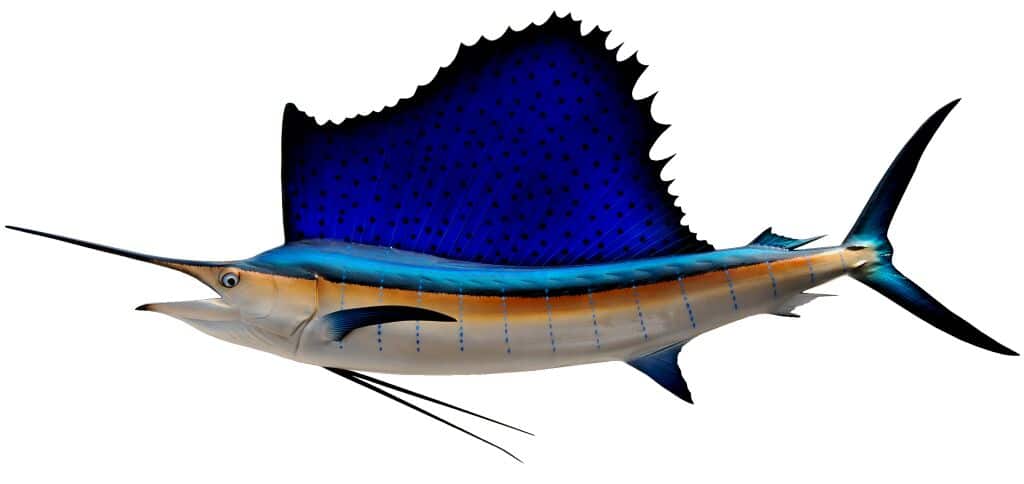
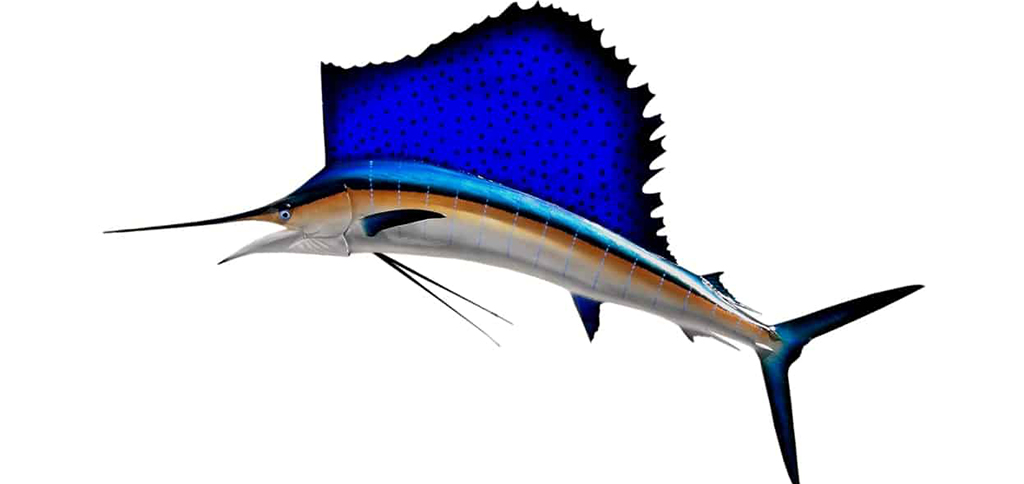
Sailfish in Central America are found in both the Atlantic and Pacific Ocean, and while very similar, they are different subspecies. The Indo-Pacific Sailfish are larger in size as they can grow to 134 inches and typically weight between 80-120 lbs. Atlantic Sailfish grow to about 124 inches and tend to be in the 60-100 lb range. Pacific Sailfish also tend to showcase a dark blue/purple tone while Atlantic Sailfish are a brighter blue.
Pacific Sailfish
Atlantic Sailfish
How to Catch Sailfish in Central America
Whether you are new to offshore sport fishing or a seasoned tournament angler, catching sailfish in Central America is something that never gets old. The warm Pacific waters off the coasts of Costa Rica, Guatemala, and Panama offer some of the most productive sailfishing in the entire world. Double and triple hookups happen regularly, as they typically live in small groups of 2-6 individuals and have been seen hunting in coordinated efforts. In Costa Rica and Guatemala, boats finishing with 10, 20 even 30 or more bites per day is common during the peak season.
Setting a Sailfish Spread
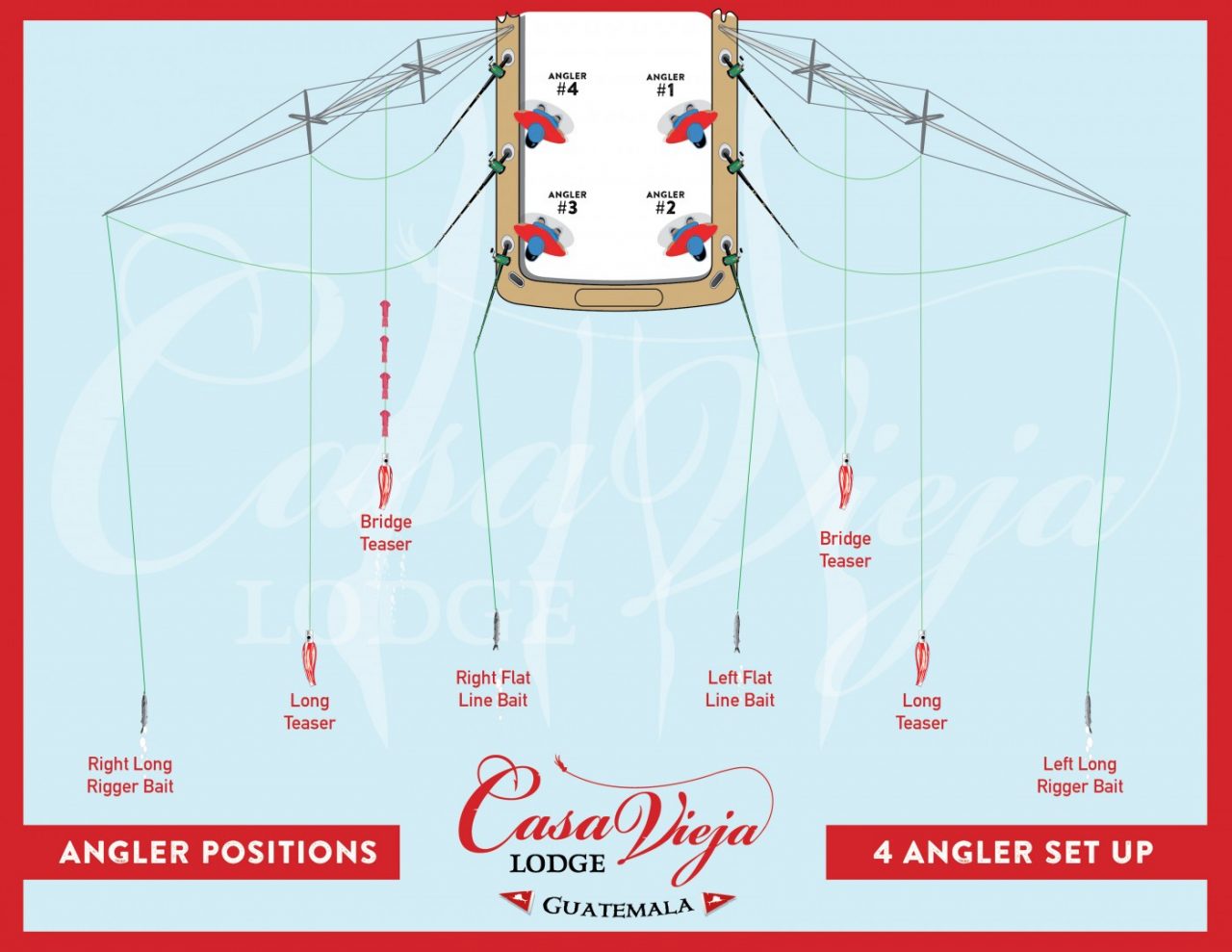
In Costa Rica and Guatemala, where the biggest sailfish numbers are caught year after year, the majority of offshore fishing boats will fish the same way. The set up of the spread can vary from boat to boat, but most captains will put out a bridge teaser on each side of the boat, which is usually a daisy chain of pink squid or flying fish. There is oftentimes a long teaser on each side as well, which is a hookless plastic squid of varying size and color patterns. Then two or three rods are baited with frozen ballyhoo rigged with circle hooks and are placed on the outrigger, near the teaser, and a flat line just off the stern. Below is an image of a traditional sailfish trolling spread behind a sport fishing boat in Central America.
Recommended Sailfish Tackle
Whether you are fishing light tackle for maximum sport or using heavier gear to handle a potential marlin in the spread, having the right equipment makes a big difference when a sailfish is tailwalking 200 yards behind the boat. Here is what our captains recommend:
Conventional Tackle
The most common setup for sailfishing in Costa Rica and Guatemala is 20-30 lb class conventional tackle. A quality lever drag reel like a Penn International, Shimano Talica, or Daiwa Saltiga loaded with 300 yards of 30 lb monofilament or 50 lb braid with a mono top shot is ideal. Pair it with a 5'6" to 6' stand-up rod rated for 20-30 lb line. This gives you enough backbone to fight the fish but enough flex to enjoy every jump. If you are specifically targeting the heavier Pacific sailfish, like we find in Panama, bump up to 50 lb class tackle. Circle hooks in the 7/0-9/0 range are standard when fishing ballyhoo, and our captains always rig them in-line to improve hook-up ratios on short-biting fish.
Light Tackle
For the angler who wants to maximize the fight, 12-15 lb class spinning tackle is as exciting as it gets for sailfish. A spinning reel in the 6000-8000 class loaded with 30 lb braid and a 40-50 lb fluorocarbon leader is plenty of line capacity for even a long-running Pacific sail. The trade-off is fight time — a big Pacific sailfish on light tackle can take 30-45 minutes to land, which is why our captains ask that you are in reasonable physical shape and up for the challenge before rigging light. This style of fishing is also harder on the fish, so proper catch-and-release technique is critical.
Fly Fishing
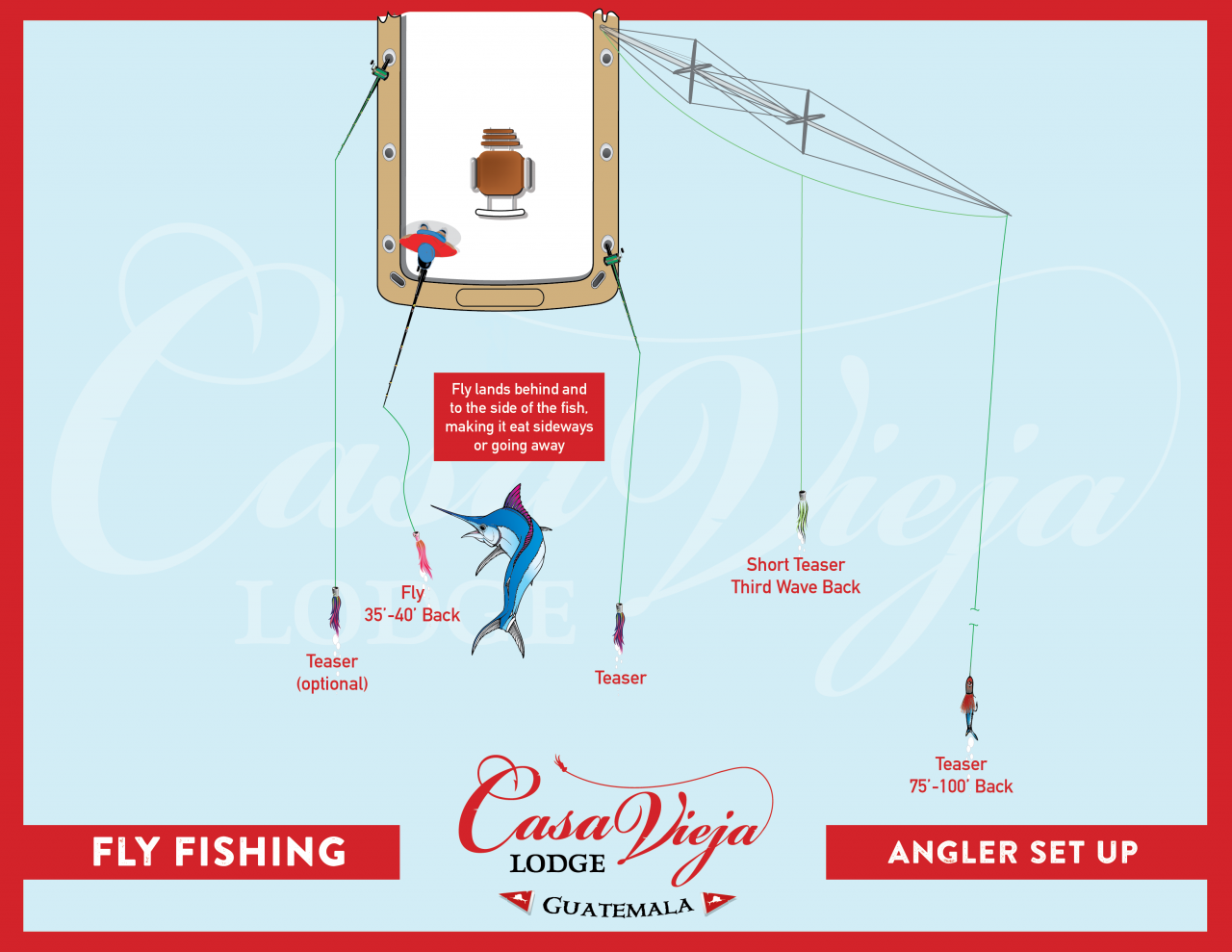
If fly fishing for sailfish is on your bucket list, Costa Rica and Guatemala are two of the best places in the world to make it happen. In both countries, you can realistically expect multiple opportunities per day during peak season as skilled mates tease fish all the way to the transom. The standard setup is a 12-14 wt rod with a large arbor saltwater reel that has a smooth, reliable drag — a running Pacific sailfish will take a lot of line in a hurry. Your leader should consist of an 8-10 ft 80 lb butt section, a short class tippet of 16-20 lbs if you are fishing IGFA rules, and a 12" shock tippet of 80-100 lb mono tied with a non-slip loop. Pink poppers to mimic squids and large deceiver patterns in blue, white, and chartreuse are the most productive flies. Bring a half-dozen extras — you will lose some. Below is the traditional spread when fly fishing for sailfish with a right handed angler.
Setting the Hook on a Sailfish
Once a sailfish (or marlin) comes into the spread or takes one of the baits, give the fish 5-7 seconds to properly swallow the ballyhoo before you gradually set the drag and begin to reel. As the circle hook exits the fish’s mouth, it will hook into the meaty portion of the jaw. You do not need to set a circle hook with a hard hook set, the circle hooks will do the work when fished properly.
What to Expect When Fighting a Sailfish
One of the most common mistakes we see from first-time sailfish anglers is pumping the rod too aggressively early in the fight. Sailfish are built for speed and acrobatics, not brute strength, so they tire relatively quickly compared to a marlin of similar size. When the fish first jumps, drop your rod tip toward it — a technique called "bowing to the king" — which takes pressure off the line during the acrobatics and dramatically reduces break-offs. Once the fish stops jumping and starts running, keep steady pressure and gain line when you can. Most sailfish in the 80-120 lb range are leader-ready in 10-20 minutes on 30 lb tackle. The mate will grab the bill, remove the circle hook with pliers, and have the fish back in the water before you even finish celebrating.
Releasing Your Sailfish
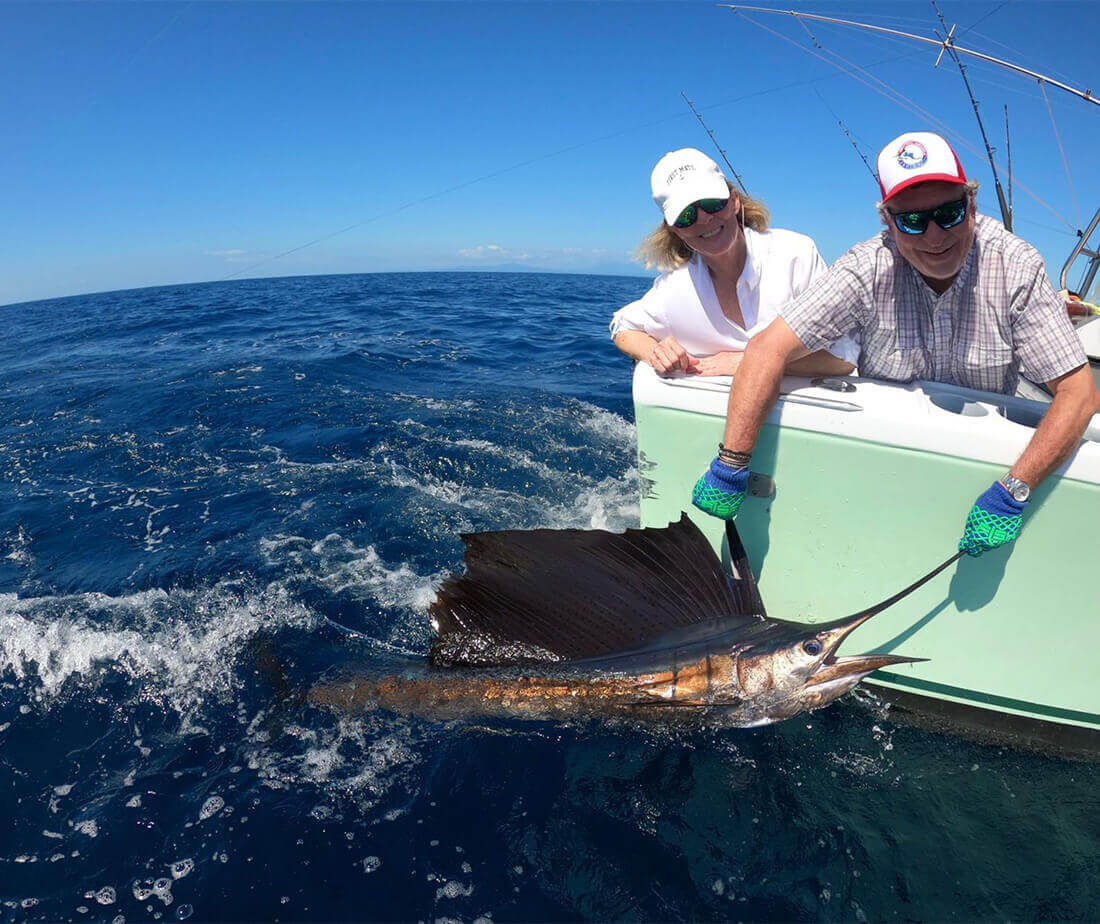
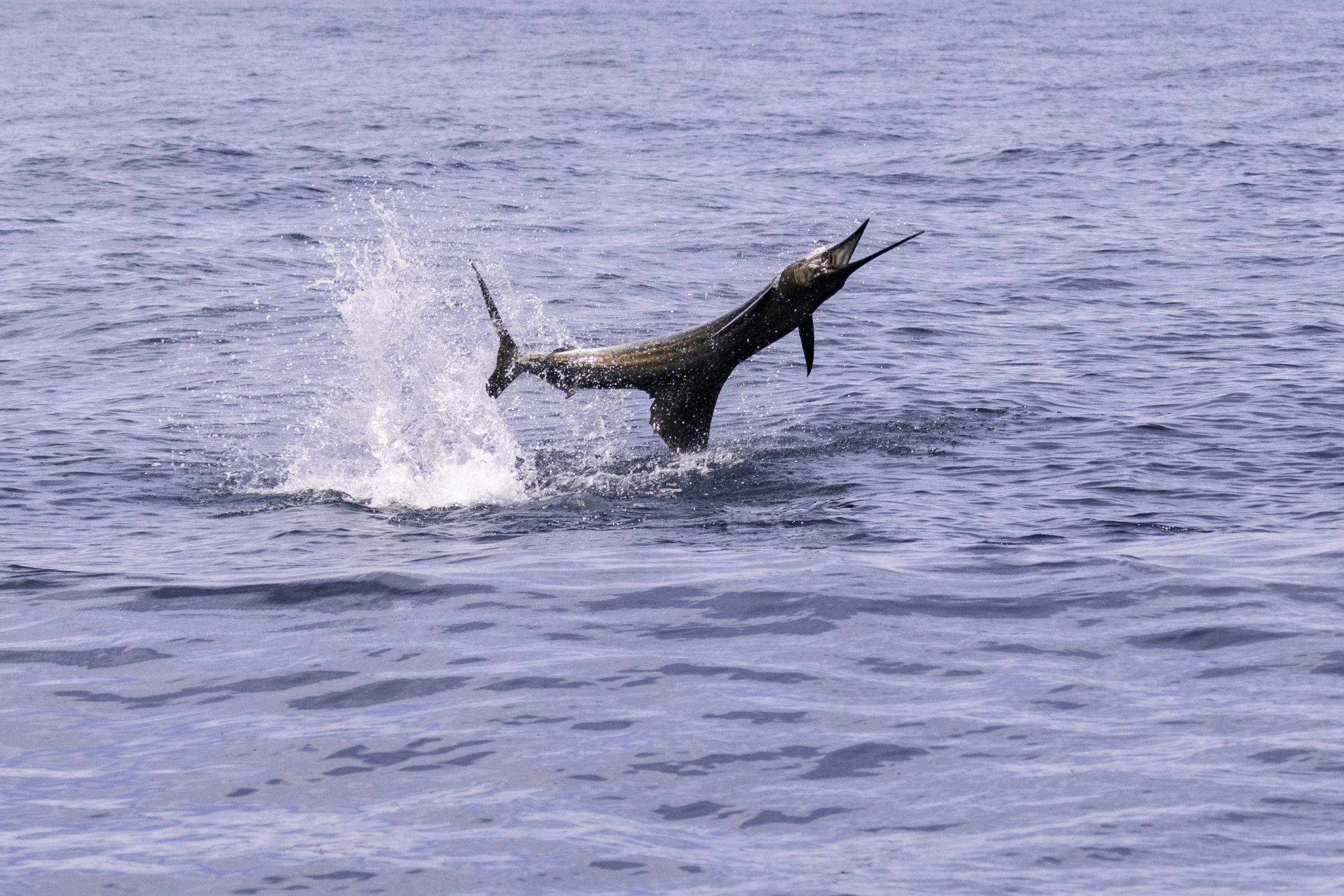
Like many fish, the best thing you can do when releasing your sailfish is to keep them in the water. For decades, pulling the sailfish up over the gunnel and onto the client's lap was common practice. The legendary Costa Rican writer and angler, Todd Staley, called this the "hero shot". Studies have proven that pulling a sailfish out of the water greatly reduced their survival rate, so now it is actually illegal to bring fish out of the water for a picture.
The best way to safely revive your sailfish is to have one hand on the bill and the other on the dorsal fin. Wearing gloves is important because the bills are slightly serrated and can cut soft, wet hands if you aren't careful. The captain will continue to have the boat in gear, and your job is to move the sailfish's head side to side to let it "breathe" and regain its strength. Once it is ready, it will push hard and swim away.
Where is the Best Destination to Catch Sailfish in Central America?
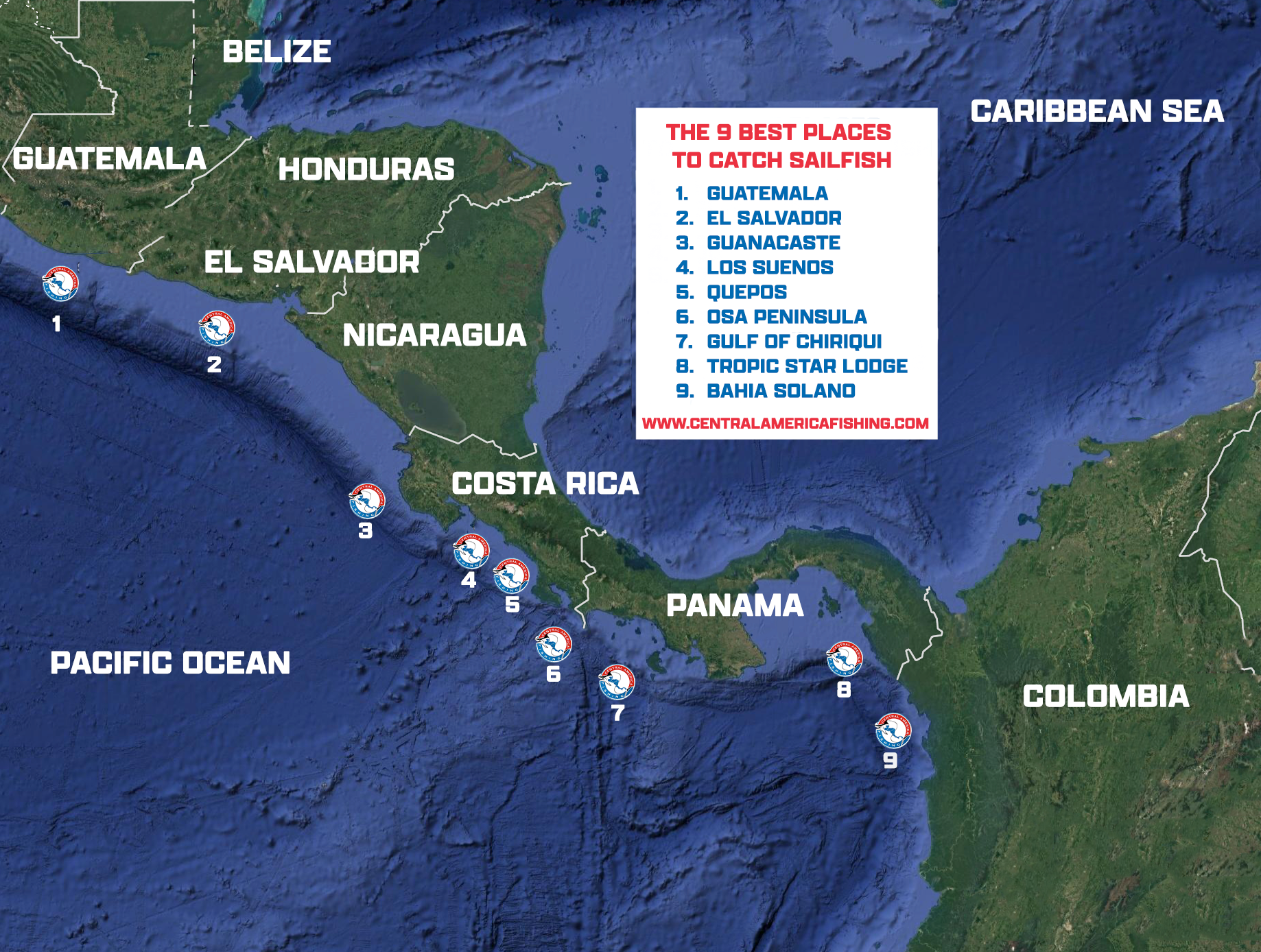
Sailfish are found in tropical waters across the entire globe. They are a migratory and pelagic fish so they are most commonly found in deep water but tend to stay above the thermocline. While sailfish can be caught in the Atlantic Ocean, the true meccas of fishing for sailfish in Central America are the Pacific Coasts. We catch sailfish from Mexico down to Colombia, but Costa Rica and Guatemala remain the cream of the crop when it comes to sailfish numbers. In the peak season, which is November through April, boats can report raising as many as 20-30 fish in a day in those two countries. Below is a map of the 9 best places to catch sailfish in Central America. This map is labeled from north to south, not in order of productivity.
When is the Best Time to Catch Sailfish in Costa Rica?
The best months to catch sailfish in Costa Rica are November through April, but we do we catch sailfish every single month of the year here. Costa Rica has rightfully earned the nickname 'The Billfish Capital of the World,' thanks to it's 12-month fishery. That said, the time of year you visit will determine which destinations offer the best conditions, so below you can see our Costa Rica Sailfish Calendar:
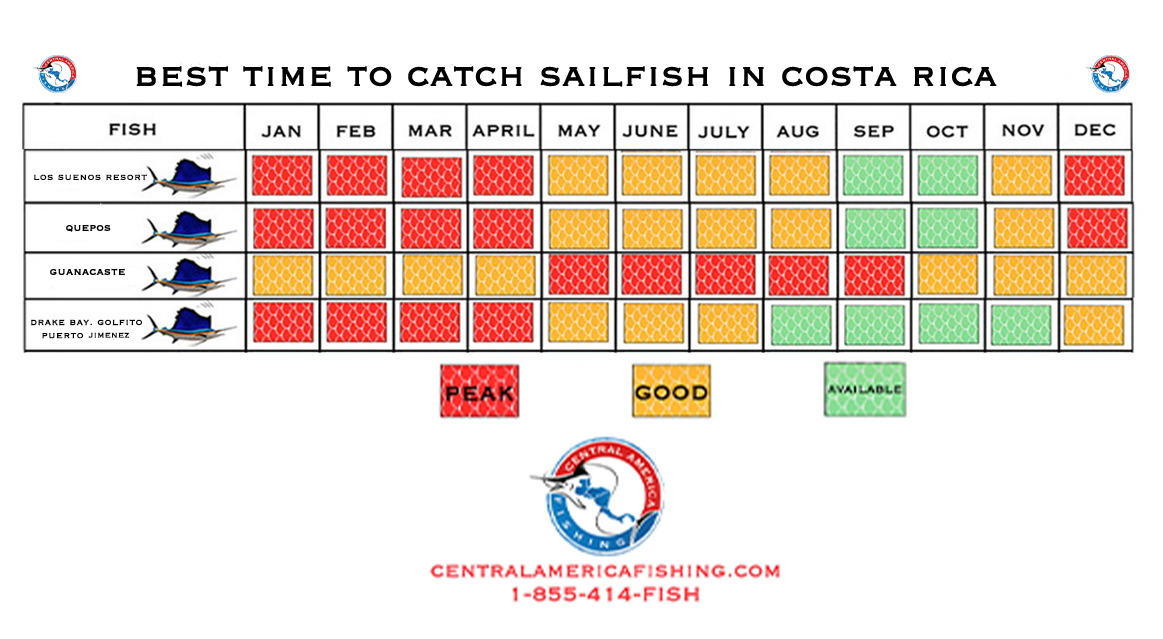
The dry season from December through April brings the best overall sailfish conditions along Costa Rica's Pacific Coast. The offshore water is clean and blue, the seas are calmer, and the baitfish concentrations are at their peak. During this period, double and triple hookups are common — it's not unusual for a boat in Quepos or Los Sueños to raise 15-25 sailfish in a single day. January and February tend to produce great numbers, but the bite can get even better in March and April with warmer waters. Better evidence of this is that all the major billfish tournaments in Costa Rica are held between January and April.
Once the green season begins in May, the fishing doesn't stop — it just changes. The offshore water can get greener close to shore as the rivers rise, but the sailfish simply move a bit further offshore to find the clear blue water they prefer. Boats that are willing to run a little further are often rewarded with wide open fishing. The green season also brings improved dorado and yellowfin tuna fishing, so mixed offshore days become very productive.
October is usually the slowest month for sailfishing along most of Costa Rica's Pacific Coast, simply because historically it brings the most rain and the sea conditions can be rough. We still catch sailfish — some great days still happen — but managing client expectations is important.
|
DESTINATION |
PEAK SAILFISH MONTHS |
SLOWEST MONTHS |
|
December through April. Consistent numbers of fish all season, with peak action in January through April. Home to multiple world-class fishing tournaments like the Pelagic Rockstar, Offshore World Championship, and the Bisbees |
September through mid-November due to the peak of the rainy season and occasionaly rough sea conditions. |
|
|
November through April. Some of the best boats and most famous captains call this marina home. Easy access to the best offshore grounds on the Central Pacific coast and easy travel from the SJO Airport (90 minutes away). |
September through mid-November due to the peak of the rainy season and occasionaly rough sea conditions |
|
|
May through October, which is the opposite of the rest of the country. The hottest & driest part of the country, when the Central & Southern Pacific start to see a lot of rain the bite moves up north along with the best weather & sea conditions. |
December through March due to the strong offshore Papagayo winds that blow consistently out of the north. The winds blow the best water out to sea and make conditions very rough most days. |
|
|
December through April for offshore sailfishing. The Southern Zone is a little further offshore than the Central Pacific, which means cleaner water even during the rainy season. |
September through November are the rainiest months in the Southern Zone, which sees more precipitation than the rest of the Pacific Coast. |
When is the Best Time to Catch Sailfish in Guatemala?
Guatemala is one of the most famous sailfishing destinations in the world, and as such has earned the nickname "The Sailfish Capital of the World". The Pacific Coast of Guatemala, centered around the port town of Iztapa, consistently produces the highest sailfish catch rates of anywhere we fish. Our top lodges average 16 bites a day, but it's common to see some boats release 30-40 sails (or more!) in a single day during peak season. The best months to catch sailfish in Guatemala are November through May, with the absolute peak running from December through April.
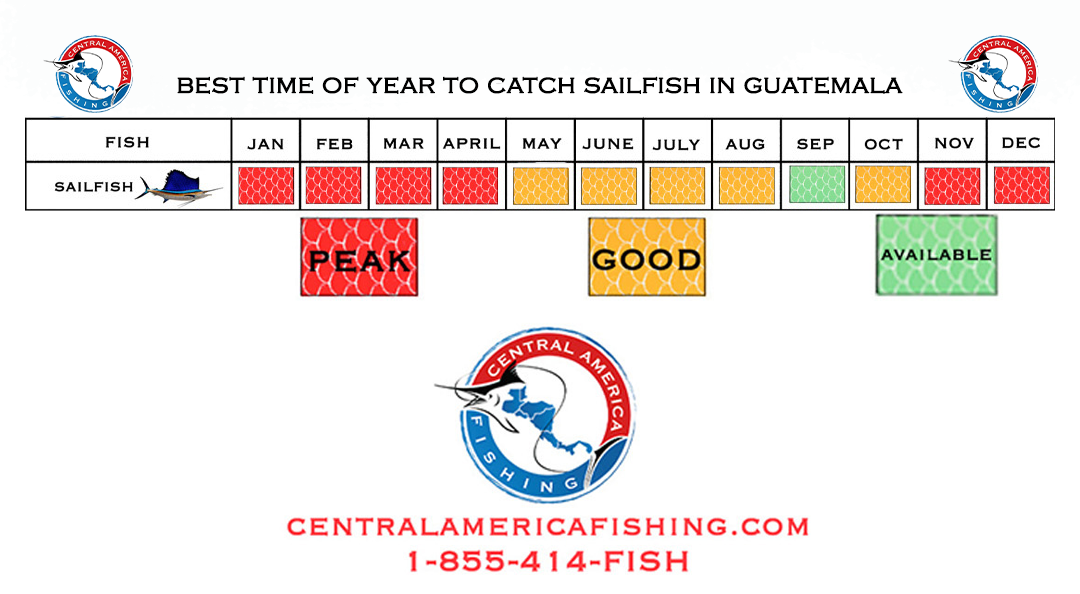
The crazy numbers behind the sailfish in Guatemala are driven by bait concentrations, ocean currents, and underwater topography. The Pacific waters off the Guatemalan coast are enriched by deep-water upwellings that push nutrients to the surface, which in turn attract massive concentrations of baitfish — and the sailfish follow. There is also a massive deepwater trench that stretches towards the coast, so oftentimes baitfish congregate there and the sailfish are close behind. The result is a fishery where double-digit releases are considered an average day during peak season. If you are a serious billfish angler and catching big numbers is the goal, Guatemala needs to be your next trip.
The fishing here is done with circle hook-rigged ballyhoo trolled behind teasers, with multiple fish in the spread at once being common. Many of Guatemala's top boats also specialize in fly fishing for sailfish, and with 10-20 opportunities per day, the fly angler who can't close the deal in the morning usually gets another chance in the afternoon.
|
DESTINATION |
PEAK SAILFISH MONTHS |
SLOWEST MONTHS |
|
Iztapa, Guatemala |
November through April, peaking December through March. Our top lodges here average 16 sailfish bites per boat/per day, but boats can release 30–40 fish on great days (sometimes 50+!). The bite stays productive through July. |
August through October. The rainy season drops numbers considerably and sea conditions become rougher, though fish are still available. |
When is the Best Time to Catch Sailfish in Panama?
The best months for sailfish in Panama are January through April, which aligns with the dry season and peak big game fishing season overall. The sailfish numbers in Panama pail in comparison to Costa Rica and Guatemala, however. Instead, Panama is more famous for its black and blue marlin bites as well as it's incredible yellowfin tuna fishery, which is one of the best in the world. That said, sailfish are available year-round and are regularly encountered on days spent trolling offshore.
|
DESTINATION |
PEAK SAILFISH MONTHS |
SLOWEST MONTHS |
|
January through April and June & July. The Hannibal Bank is primarily targeted for marlin, but sailfish are regularly caught here as well. Sailfish are most common from Feb to April with the warmer waters. |
August through November. The rainy season and choppy seas slow the offshore fishing in Panama considerably. |
|
|
December through July. Tropic Star is world-famous for marlin, but their crews can put up great sailfish numbers in the deep Pacific waters off Piñas Bay. |
August through November. The lodge closes for part of October for annual maintenance. |
Are Sailfish Edible?
Sailfish meat itself doesn't taste bad and it is eaten in some part of the world, but in Central America they are a protected species. All billfish are strictly catch-and-release, so no sailfish are to be harvested.
How Many Sailfish Can I Expect to Catch?
As with any type of fishing, there is never a guarantee you'll catch a single sailfish, so any day you catch one is a successful day. The good news is that sailfish are one of the most abundant offshore species in Central America, and when conditions align — blue water, active baitfish, and the right current — they can be caught in bunches.
In Guatemala during peak season, the realistic expectation is 10–20 releases per day per boat, with exceptional days seeing 30–40 or more. In Costa Rica, a great day during the dry season is 10–20 bites with 8–15 releases. In Panama, sailfish are not as heavily targeted, so a good day is 3-5 fish in the Gulf of Chiriqui. On the other side of Panama, some exceptional days at the Tropic Star Lodge can see 10-20 sailfish.
The CAF record for sailfish in a single day is 28 releases, set by repeat guest Greg M. in January 2026 fishing out of Quepos aboard the Carolina Blue with Captain John.
Chris Atkins, owner of Central America Fishing, holds a personal record of 19 sailfish in a day. I did this in Quepos in March 2012 and again in Guatemala in May 2016. My best fly fishing day was going 3 for 5 on that same day in Guatemala out of the Casa Vieja Lodge.
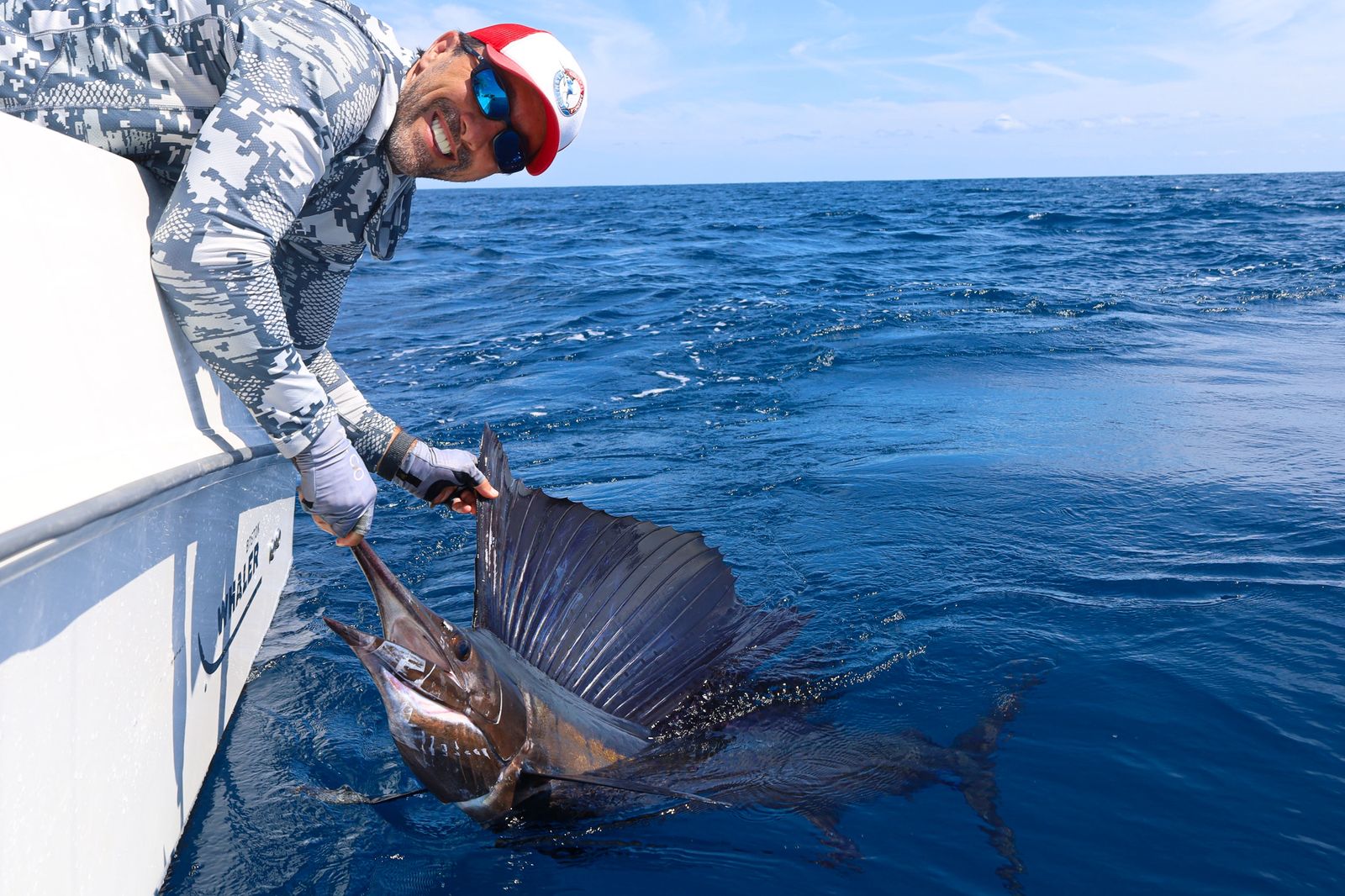
What is the World Record for Sailfish?
The IGFA all tackle record for Pacific sailfish is a whopping 221 lbs. This was caught near Santa Cruz Island in Ecuador back in 1947. Several line class world records were set right here in Costa Rica and Panama. For the fly anglers out there, literally 100% of all IGFA tippet class world records were set in Costa Rica or Panama.
The all tackle record for Atlantic sailfish was caught off the coast of Angola in 2014 and weighed 142 lbs 6 oz.
Planning Your Trip to Catch Sailfish
Instead of spending hours researching online, working with CAF for your next sailfish adventure makes the planning phase easy, the travel logistics seamless, and it costs you the exact same as trying to figure it all out on your own anyway. We already know which destination to pick for your dates, which lodge/resort/boutique hotel/villa/ or marina to base yourself in, and which captains are the right fit for your group. Some hardcore captains want to catch as much fish as possible and talk very little, others are great fun and great anglers, and some are fantastic teachers. That's where 20+ years of local experience makes a real difference. Central America Fishing has put thousands of clients on sailfish across Costa Rica, Guatemala, and Panama, and with 40% of our guests being repeat & referral anglers, we do a great job putting you in the right spot at the right time. Call us at 1-855-414-FISH to talk through your options and your interests, or fill out an inquiry form online and we'll get back to you within 24 hrs.
A sailfishing trip with CAF can take on many forms. For some anglers, a single offshore day mixed into a beach vacation is all they want — and even one day is enough to experience the excitement of billfishing. For the hardcore anglers, a laser-focused sailfishing trip to Guatemala for four nights with three days of fishing is the right fit. For the majority of CAF anglers, they visit us for a week, fish 3-4 days with a mix of offshore and inshore fishing, do a few eco and adventure tours, and have a day or two to relax. Whatever your style and budget is, we'll work with you to custom build the best fishing vacation of your life.
Sailfish FAQs
Where is the best place in the world to catch sailfish?
Guatemala is considered the best sailfishing destination in the world based on sheer catch rates. Boats out of Iztapa regularly release 20-40 sailfish per day during peak season, numbers that are unmatched anywhere else in the world. For that reason, it has earned the nickname "the Sailfish Capital of the World."
Costa Rica is a very close second and offers the advantage of also having world-class inshore fishing, marlin, tuna, and more variety than Guatemala.
When is the best time to catch sailfish in Central America?
The best overall months for sailfish in Central America are November through April. This coincides with our dry season, or summer weather along the Pacific Coast. We catch sailfish every month of the year, but some months are historically more productive than others.
Guatemala: the peak season is November to April, but the best months are January through March.
Costa Rica: the peak season is December to April in the Central & South and then May-Aug in the North.
Panama: the peak season is February to April.
Are sailfish catch and release in Central America?
Yes. All sailfish in every single Central American country are strictly catch-and-release for sport fishing boats. This policy, enforced by law and enthusiastically practiced by captains across the region, is a big reason why the fishery remains as strong as it does. Circle hooks are standard practice and make releasing fish cleanly much easier, as the hook typically sets in the corner of the jaw rather than deep in the throat.
How Big are Sailfish in Central America?
The Indo-Pacific Sailfish are larger in size as they can grow to 134 inches and typically weight between 80-120 lbs. Atlantic Sailfish grow to about 124 inches and tend to be in the 60-100 lb range. A large Pacific sailfish is anything over 150 lbs.
Can I fly fish for sailfish in Central America?
Yes — Central America is one of the best places in the world to fly fish for sailfish. In Costa Rica and Guatemala, experienced mates will tease sailfish all the way to the back of the boat so the fly angler can present their fly to an agitated, close-range fish. We have a select few, hand-picked captains that specialize in fly fishing and will even provide all fly tackle for you. If you bring your own tackle, we recommend a 12-14 wt rod with an 80 lb butt section and 16-20 lb class tippet.
How do I book a sailfishing trip to Central America?
The easiest way is to call us at 1-855-414-FISH or fill out our inquiry form and tell us your target dates, group size, and how many days you'd like to fish. We handle everything from there — in-country transportation, lodge or hotel accommodations, any non-fishing tours, and your private fishing charters. We'll look at historical trends and our recent fishing reports to make sure you are in the right spot at the right time for the best sailfishing.
Because we earn our revenue through commissions from our partners rather than booking fees, you pay the same price whether you book through us or book everything yourself. Our local expertise just saves you the headache, and our in-country Guest Services team puts you at ease the entire time you are here.